Priya and Mark Templeton introduced a no-screens rule for their two-year-old daughter, Asha, in July, after a paediatrician mentioned screen time only in passing and the couple went home and implemented a household policy stricter than anything either of them has encountered at work. Tablets were hidden. The television was unplugged and, for reasons neither parent can now fully justify, turned to face the wall of their Elsternwick living room.
The rule was, by the Templetons' own account, a straightforward success for roughly nine days. Then Asha began pointing out, with the specific cruelty only a toddler can manage, that her father checks his phone at the dinner table and her mother "watches the shows" after Asha goes to bed. Having built their entire parenting case for the week around the phrase "we don't do screens in this house," the Templetons found they had no rebuttal.
"She's not wrong," Mark said. "She's two. She shouldn't be able to out-argue me on anything, let alone media consumption habits, and she did it using a sentence structure she can't even reliably use for other things."
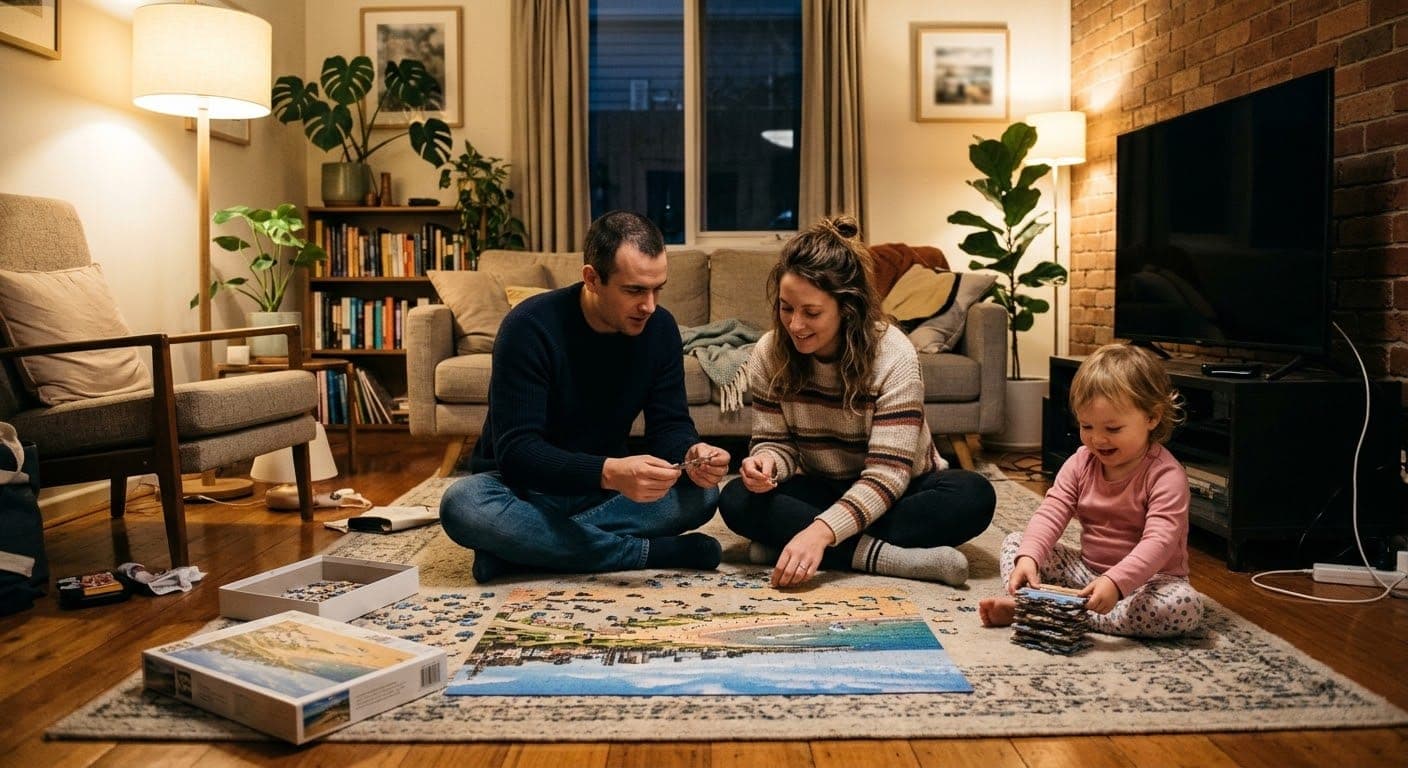
The no-screens rule has since been quietly extended, first to dinner, then to the hour before bed, then, as of three weeks ago, to the whole house after 6pm, a change the Templetons have not formally announced to each other but have both separately started enforcing. Mark has rediscovered a stack of paperbacks bought in 2019 and never opened. Priya has become, by her own description, "unreasonably good at a 500-piece puzzle of Brighton Beach," a spot she still hasn't visited in person despite it being a short drive away.
Asked whether the extended rule had been difficult, Priya said the hardest part was the first ten minutes of each evening, which she now spends staring at the dark television rather than her phone, out of what she assumes is habit rather than any genuine desire to watch it. "I thought we were protecting her from something," she said. "I think we were protecting ourselves from a rule we were too embarrassed to make for just us."
Asha, for her part, has reportedly started requesting the puzzle by name, and was last seen attempting to sort its pieces by colour, a detail her parents have chosen to interpret as encouraging rather than, as one grandparent suggested, "the exact same thing you two are doing, but with cardboard."