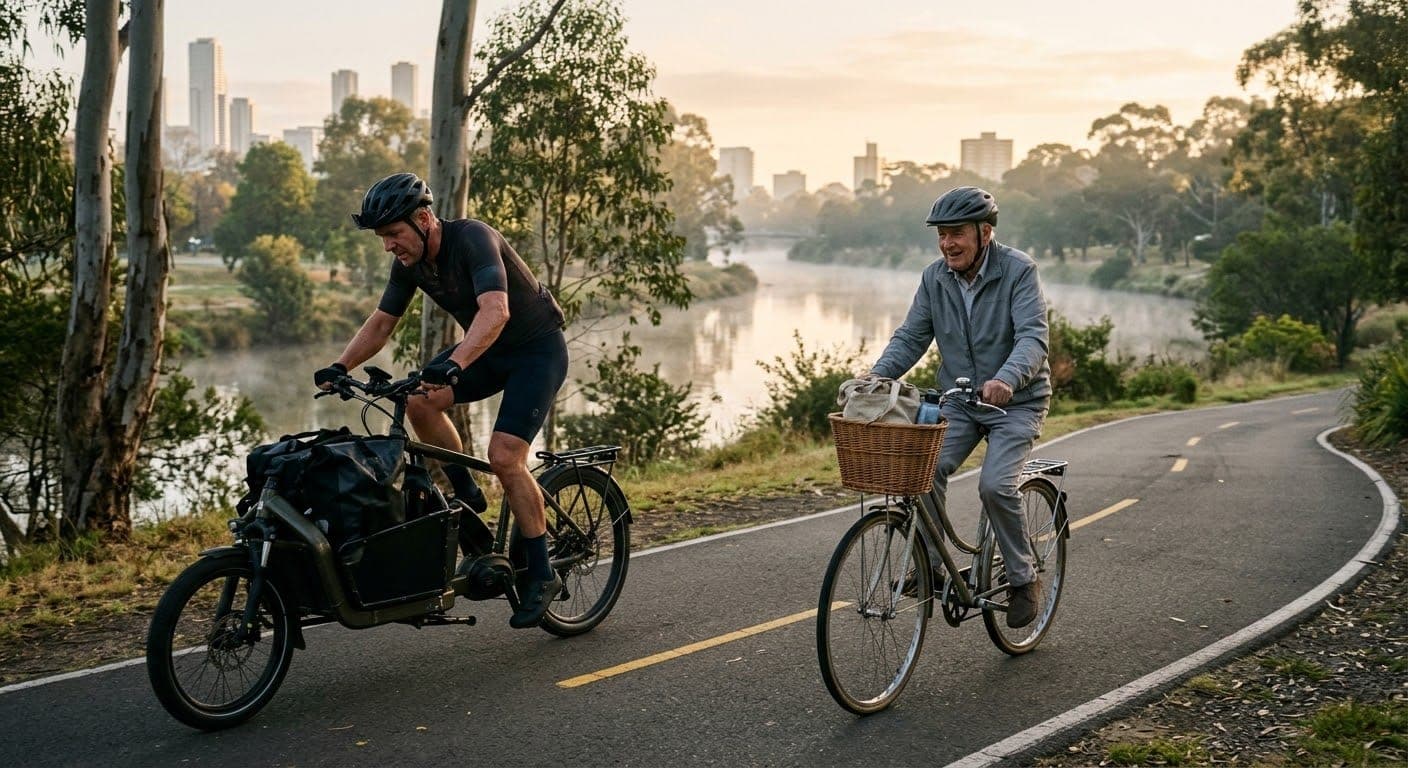
Craig Delahunty, 41, spent six weeks researching e-bikes before buying a Dutch-style cargo model with a torque sensor he admits he still cannot fully explain, on the understanding that it would cut twenty minutes off his commute from Fairfield to the city along the Main Yarra Trail. It has not cut twenty minutes off his commute.
The $4,200 purchase, made after a spreadsheet comparison of six models and a trial ride Delahunty now describes as "misleadingly uncrowded," was meant to solve a straightforward problem: he was tired of being the slowest person on the trail. He is still the slowest person on the trail. He is simply slower on a heavier bike.
The stretch of path past Dights Falls and under the Heidelberg Road bridge has introduced Delahunty to a hierarchy of commuters he did not know existed before owning an e-bike with the legally mandated assisted top speed of 25 km/h that applies to pedal-assist bikes in Australia. Road cyclists in full kit pass him without acknowledgment. A council worker on what appears to be a shared fleet bike has beaten him to the Studley Park Boathouse turn on three mornings running. Most damagingly, an older man on what Delahunty will only describe as "a bike from maybe 1974, with a basket, and no visible gears" has overtaken him twice this month on a flat section with no wind assistance of any kind.
"I bought the bike so I wouldn't be the slow one," Delahunty said, checking his phone's ride-tracking app, which he opened specifically to not look at during this conversation. "I am now definitively the slow one. I am just slow with a battery."
Delahunty's partner, Ange, has continued commuting the same route on a twelve-year-old hybrid bicycle with a basket of her own and, by her own account, arrives at work "basically the same time, for nothing." She has declined to discuss the matter further, citing a desire to keep at least one relationship in the household free of spreadsheets.
Delahunty has since investigated upgrading to a higher-wattage motor, a purchase he concedes would resolve nothing, since the man with the 1974 bike does not appear to be using a motor, a gear system, or any detectable effort. He has instead begun leaving ten minutes earlier, which he has not yet told Ange, on the theory that if no one sees him lose, it does not fully count.