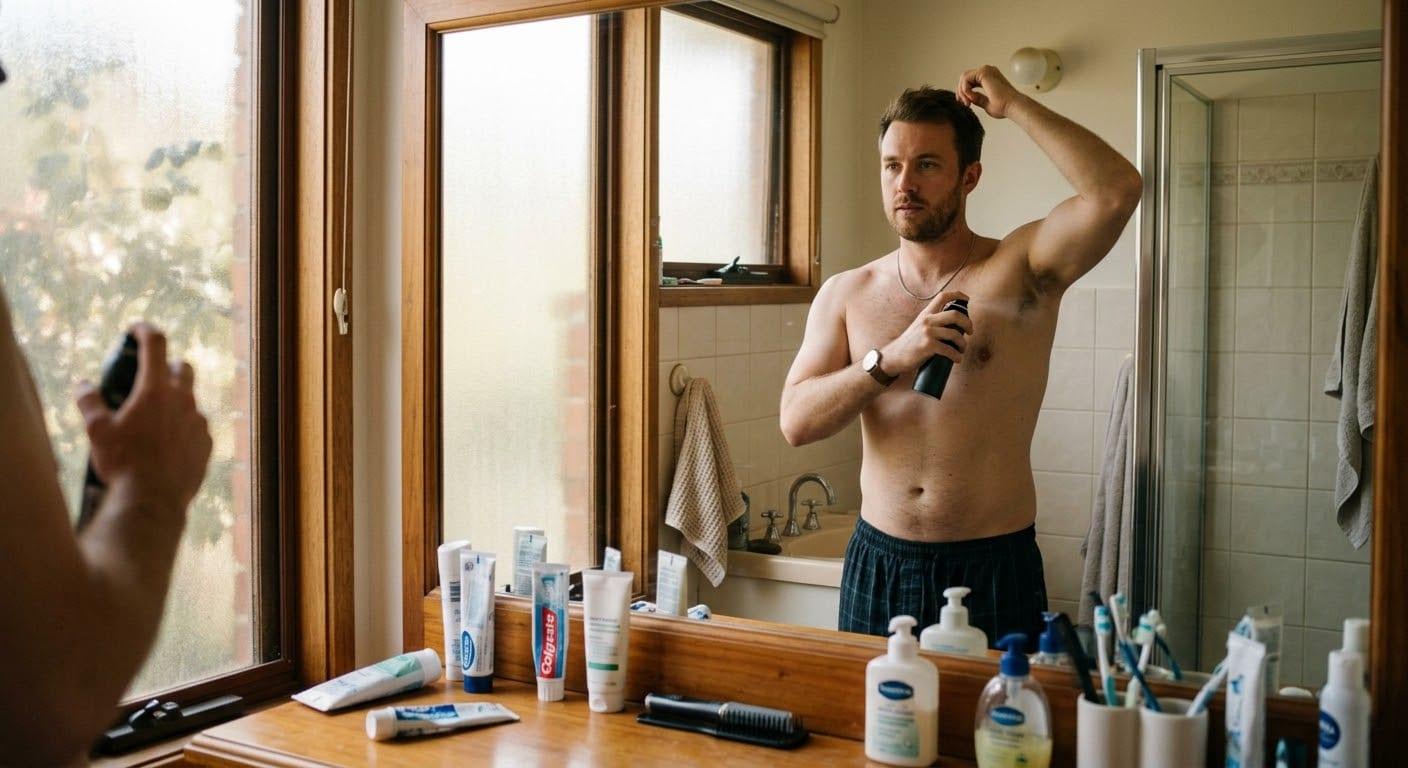
Liam Castellan keeps two deodorants in rotation, a travel-sized antiperspirant in his backpack for midday top-ups, and a habit, acquired somewhere in his twenties, of checking his own underarms by smell before most meetings, dates and family gatherings, a motion he has refined over the years into something almost undetectable to anyone watching.
He traces the habit, loosely, to nothing in particular. No single comment, no specific incident. "I don't think anyone's ever actually said anything to me," he said, from the kitchen of his Heidelberg townhouse, mid-application. "I just always assumed someone might, eventually, and I didn't want to be caught out."
In 1919, an American deodorant company called Odorono ran a full-page advertisement in Ladies' Home Journal under the headline "Within the Curve of a Woman's Arm," built around the suggestion that a woman might be offending the people around her without knowing it. It was written by a young copywriter named James Young, working for the J. Walter Thompson agency, who later recalled that women in his own social circle stopped speaking to him over it; around two hundred Ladies' Home Journal readers cancelled their subscriptions outright, finding the subject too indelicate for a women's magazine to raise at all. The campaign worked anyway. Odorono's sales, which had gone flat, rose 112 per cent the following year to $417,000, and by 1927 the company's sales had reached $1 million.
Liam learned this history recently, in the course of a research spiral down a thread he still can't fully explain starting, and found it clarifying in a way that has not changed his behaviour in the slightest. "It's wild that this whole category of worry got invented on purpose, in a magazine, by one guy trying to sell more bottles," he said. "And I still checked under my arm literally this morning, before I'd even had coffee."
He has, if anything, become slightly more diligent since learning the history, on the theory that knowing a worry was manufactured a century ago doesn't do much to switch it off in practice, and that he would rather not volunteer himself as the test case for finding out otherwise.