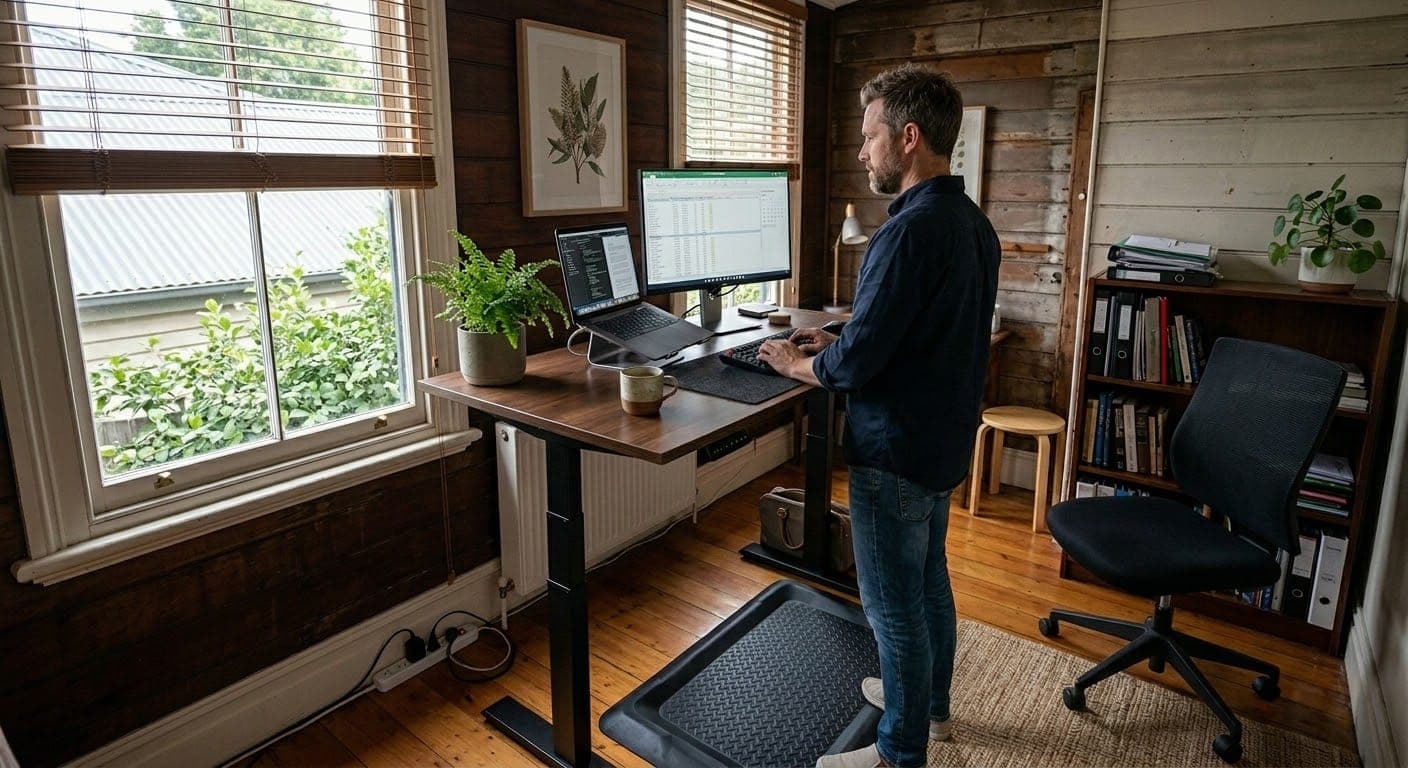
Trent Iosefo, 34, bought an electric sit-stand desk for his home office on Harold Street, Thornbury, in March, after a physiotherapist on High Street told him his lower back pain was caused by eleven straight hours a day in an office chair that cost $60 from a hard rubbish pile in 2019. The desk cost $899. The back pain is gone. In its place, Mr Iosefo now has a condition his podiatrist describes, somewhat reluctantly, as "generalised foot and calf unhappiness."
Mr Iosefo stands for his entire working day, a habit he adopted after reading that standing burns marginally more calories than sitting and that "the new cigarettes is basically just sitting down." He stands through video calls, through lunch, through a 4pm stretch break that involves more standing. He has stood for so consistently long that his downstairs neighbour, who can hear the desk's motor rising and falling through the floor at irregular intervals, has started referring to it as "the lift."
By July, Mr Iosefo's feet hurt enough that he bought a $140 anti-fatigue mat, designed specifically for people who stand at desks, to stand on while standing at his desk. By September, the mat had stopped helping, and he bought compression socks. By October, on the advice of the same podiatrist, he bought an $800 ergonomic chair, the kind with lumbar adjustment and a headrest, to sit in for part of each day so his feet can recover from standing in order to protect his back from sitting.
He now alternates between the chair and the desk roughly every forty minutes, a system he has started tracking in a spreadsheet, which he fills in while standing. Asked whether this was, in total, more expensive and complicated than the original back pain, Mr Iosefo said he hadn't thought about it that way and would prefer not to.
His partner, who works from the kitchen table on a laptop with no adjustments of any kind and has no back pain, declined to comment beyond noting that the desk's motor is very loud at 6:45am.